
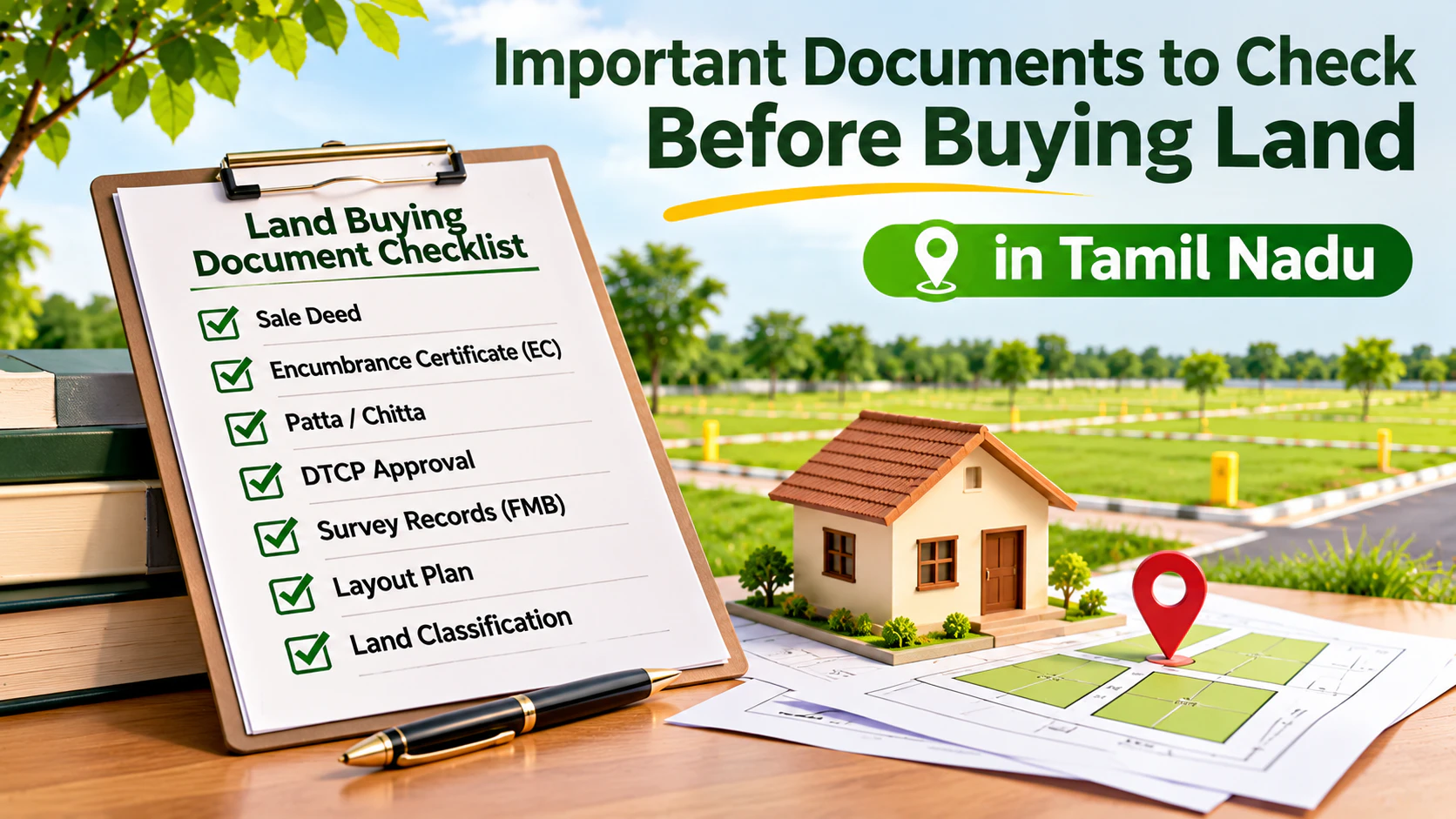
Purchasing land is a significant financial commitment that requires careful planning and legal verification. Whether you are buying a residential plot to construct your dream home or considering land for future investment, examining the relevant property documents is essential. In Tamil Nadu, buyers should understand ownership records, planning approvals, land classifications and survey details before proceeding with any transaction. Areas such as Cuddalore, Kallakurichi and Salem offer different property options, but the importance of proper documentation remains the same. This guide explains seven important document checks that can help buyers make informed property decisions.
1. Registered Sale Deed and Ownership Documents
The registered sale deed is one of the primary documents used to establish how ownership of a property was transferred. It contains important information such as the names of the parties involved, property description, survey numbers, transaction details and boundaries. Buyers should examine the current sale deed along with previous ownership documents to understand the property's title history. Reviewing the chain of ownership can help identify missing documents, inconsistencies or other issues that require legal clarification. Since property ownership can involve complex legal questions, obtaining an independent title verification from a qualified property lawyer is strongly recommended before completing the purchase.
2. Encumbrance Certificate (EC)
An Encumbrance Certificate, commonly called an EC, provides information about certain registered transactions affecting a property during a selected period. Buyers commonly review this document to identify registered sales, mortgages and other recorded encumbrances. The property details, survey numbers and names appearing in the EC should be compared with the relevant ownership documents. However, an EC does not necessarily reveal every legal claim, unregistered transaction or property dispute. Therefore, it should be treated as one part of a complete legal due diligence process rather than as independent proof of clear title.
3. Patta and Relevant Land Revenue Records
Patta is an important land revenue record used in Tamil Nadu. It may contain details relating to the recorded landholder, survey number, subdivision, land classification and property extent. Buyers should compare Patta information with the sale deed and other supporting documents to identify discrepancies. Depending on the property, additional revenue records may also need to be reviewed. It is important to remember that revenue records alone do not conclusively establish legal ownership. Their role is to support the overall verification of the property's identity, classification and recorded details.
4. DTCP Layout Approval and Planning Permission
When purchasing a plot within a residential layout, buyers should verify whether the development has obtained the required approval from the appropriate planning authority. In Tamil Nadu, some layouts fall under the Directorate of Town and Country Planning, while others may be regulated by different competent authorities. Examine the applicable approval number, approved layout drawing, plot identification, access roads and any conditions attached to the approval. The specific plot being purchased should match the approved layout details. Planning approval does not replace ownership verification or guarantee permission for every proposed building activity.
5. Survey Records, FMB Sketch and Plot Boundaries
Survey documents help identify the location, measurements and boundaries of a property. A Field Measurement Book (FMB) sketch, where applicable, can provide useful information about surveyed land measurements. Buyers should compare the survey number, subdivision, extent and boundaries mentioned in the sale deed with relevant survey records. Physical measurements should also be checked during a site visit. If there are uncertainties or differences between documents and the actual property, assistance from a qualified surveyor can help clarify the boundaries before purchase.
6. Land Classification and Legal Access
Before buying residential land, it is essential to understand whether the property's land use and classification are suitable for the intended purpose. Certain properties may be affected by planning restrictions, access limitations or other applicable legal requirements. Buyers should verify the property's classification through relevant records and confirm that it has lawful road access. The presence of a visible pathway does not always establish a permanent legal right of access. Checking these details early can help prevent difficulties related to construction, property use or future transactions.
7. Property Document Guidance with Nilamangai Estates
Nilamangai Estates helps buyers explore residential plots and customised villa opportunities across Cuddalore, Kallakurichi and Salem. Our team focuses on understanding customer requirements, explaining available property options and supporting informed property searches. When evaluating residential land, buyers should request the relevant ownership documents, layout approval information and survey details for the selected property. A qualified independent legal professional should review these documents and advise on any additional verification required before a transaction is completed.
Conclusion
Verifying property documents is one of the most important steps when buying land in Tamil Nadu. The registered sale deed, Encumbrance Certificate, Patta, planning approval, survey records, land classification and access details all contribute valuable information about a property. However, no single document should be relied upon as complete proof of legal safety. Buyers should carefully review the available records, physically inspect the land and obtain independent legal guidance before making payments or signing agreements. With proper research and informed planning, you can approach your property purchase with greater confidence.